
Harvard Human Flourishing Program + HumanConnections.AI | Social AI White Paper
May 16th, 2025 - Our HumanConnections.AI initiative published a white paper via the Harvard Human Flourishing Program called: Social AI and Human Connections: Benefits, Risks and Social Impact. Drawing on a review of recent literature, expert interviews, a Salon with leading technologists and scholars of human flourishing, and webinars with Social AI researchers, the paper explores the question: How might we design AI systems for social connectedness and human flourishing?
From the summary:
“Imperative
The widespread consumer adoption of social media technology since the mid-2000’s, while having many positive benefits, has also corresponded with a precipitous decline in our ability to socialize, especially in person. Public and social institutions failed to meet the moment on social media, and we have an obligation to get it right on AI. Leading collective action to repair the social fabric of democratic societies—and avoiding exponential damage—will require a shared framework for understanding and evaluating how new AI technologies will impact human flourishing on both individual and societal levels.
Two Trends:
Declining Human Social Capabilities and Advancing AI Social Capabilities This white paper documents two trends at the heart of this challenge: • First, Americans are losing the capability to socialize in person. Multiple measures of social connectedness are heading in the wrong direction with dire consequences for our mental health, the well-being of our communities, and the future of democratic governance. • Second, AI chatbots are being rapidly adopted and have become increasingly sophisticated at mimicking the social and emotional capabilities of human beings. These two trends are now meeting together in the rise of Social AI, conversational AI systems that are purposely designed to fulfill a human’s need for social connectedness typically fulfilled by other humans. While there may be benefits from human interactions with Social AI, this white paper warns that substituting genuine human connections with AI-mediated interactions may exacerbate societal divisions and undermine our social fabric.
Stakeholder Recommendations for Systemic Change
Based on these conversations and research, we evaluated the systemic context of Social AI, surfacing stakeholder recommendations in five systemic change categories.
The following are illustrative examples:
1. AI Systems: Create metrics for social connectedness and human flourishing that build on what already exists, and support these metrics with a business case.
2. AI Businesses: Create Social AI case studies showing different business outcomes (product liability, brand impact, etc.) of different business models.
3. AI Markets: Create a “LEED Certification” for consumer-facing AI products that help humans flourish in their communities
4. Political Systems: Create a design code for AI, youth and social connection that can be tested and validated by independent bodies.
5. Cultural and Social Systems: Conduct citizens’ assemblies, deliberative polling and community dialogues on Social AI policies and norms.”
Teubner, Jonathan and Ivey, Ronald, Social AI and Human Connections: Benefits, Risks and Social Impact (May 16, 2025). Available at SSRN: https://ssrn.com/abstract=5256743 or http://dx.doi.org/10.2139/ssrn.5256743
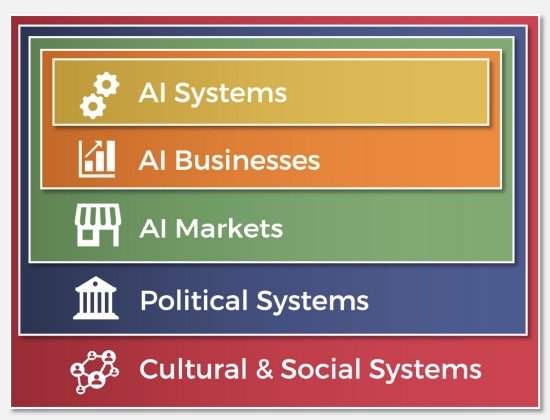
Framework for Systemic Change, see page 25.